

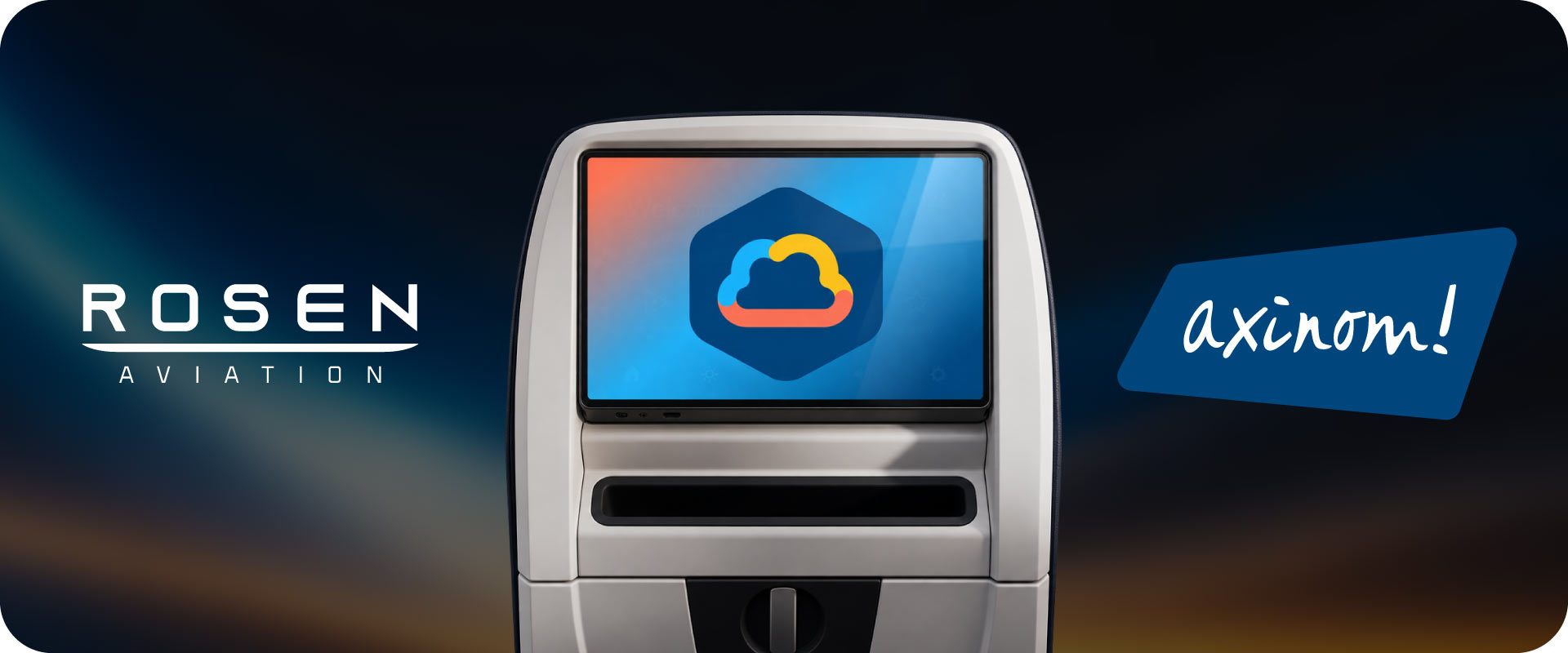
Axinom and Rosen Aviation Launch a New Connected Seatback Platform
A light-weight, cloud-powered wireless seatback the airline owns and controls, built jointly by a hardware and a software specialist.
Eugene, Oregon / Fürth, Germany — September 15, 2026 — Rosen Aviation and Axinom today announce a new Connected Seatback Platform, a light-weight, cloud-powered wireless seatback platform in which the screen operates as the airline’s own digital surface in the air, with use cases far beyond in-flight entertainment. The joint solution combines displays provided by Rosen Aviation with Axinom’s software platform, and together the two companies are uniquely positioned to make this a genuinely new approach to the seatback in a LEO-connected world. It gives airlines a single foundation for entertainment, commerce, loyalty, disruption management, and any other service they choose to build, with the cloud serving as the brain.
The platform inverts the architecture the industry has used for decades. Today’s seatback is organized around in-flight entertainment with proprietary on-board servers and wired, heavy screens acting as terminals that work only inside one vendor’s closed system. In the light-weight Connected Seatback Platform, the seatback screen is the central entity that is connected to the cloud. The cloud holds the content, the application logic, the commercial workflows, and the passenger data.
Rosen Aviation sources displays from all major manufacturers and carries out the avionics engineering, electronics development, and structural integration in-house, so the display is built to the airline’s specification rather than chosen from a catalog. Critically, the design features enable the lightest displays possible, ranging from 11 to 97 inches, covering economy seatbacks, premium cabins, large shared cabin surfaces, and curved panels that can become digital windows and skylights when fed by external cameras. In-seat spatial audio adds a personalized three-dimensional sound field at the seat, potentially eliminating the need for headphones. Where to invest is a decision per cabin: the same software foundation provided by Axinom runs across the whole aircraft, while the fit-out is chosen class by class.
Axinom’s software functions as a foundation the airline builds on rather than a closed product. Axinom On-Board Cloud extends the airline’s cloud infrastructure onto every device in the cabin, so each seatback screen is an edge node of that infrastructure rather than a terminal of an on-board system, exchanging data with lighting, seats, sensors, and crew tablets over the open ARINC 853 / Cabin Secure Media-Independent Messaging (CSMIM) standard.
Applications of any kind, selected or built by the airline, run on the same platform, and the passenger using them is identified. A passenger signs in with their own airline account from their personal device, bringing loyalty status, preferences, and flight context to the screen and making commerce, upgrades, destination services, and advertising possible against an identified passenger. The airline’s licensed entertainment and third-party OTT services stream directly from the cloud with edge caching on the screens themselves, and entertainment is only one use case among many. The software layer and the data generated on it stay with the airline.
“Move the brain to the cloud and everything changes. The screen stops being an entertainment terminal and becomes a device the airline can build on, the catalog stops arriving on a loading schedule, and the passenger at the seat is finally someone the airline knows rather than an anonymous session,” says Ralph Wagner, CEO of Axinom. “Rosen is the ideal partner for this, with all the industry-specific knowledge and capabilities needed to rethink the cabin from the ground up.”
Axinom’s architecture requires no IFE head-end server, and the screens provided by Rosen Aviation are WiFi-enabled, requiring no wires to receive data. Therefore, the cabin data wiring and the server rack are no longer needed: wiring to the seat carries power only, and each screen receives its data wirelessly over gate-to-gate LEO satellite connectivity, running the airline’s applications on its own processing power. The aircraft carries less weight, installation and retrofit are substantially simpler, and the content loading cycle disappears along with the wiring. Instead of a weekly or bi-weekly pre-load, content, applications, and configuration reach every screen over the air and can be changed at any time without anyone boarding the aircraft. Cabin layout and in-flight entertainment are decoupled as well: seats can be reconfigured without reworking the system, and a single display can be replaced and registered from the ground.
“Taking the data wiring out of the cabin raises the bar for the display. Each screen has to run the airline’s applications on its own and hold up in a commercial cabin for years,” says Lee Clark, Senior Vice President Strategy at Rosen Aviation. “That is the standard we have built to in business aviation for decades, and we are bringing it to commercial volumes. Axinom is the most disruptive software company in this field, and that is exactly what the screen needed.”
The two companies will showcase the platform publicly at Aircraft Interiors Expo 2027 in Hamburg. A sneak preview of the platform will be given ahead of that at APEX FTE EXPO Asia in Singapore, November 18–19, 2026. Airlines interested in an earlier conversation can contact either company directly.
About Axinom
Axinom provides software products that connect cloud and cabin, enabling use cases from in-flight entertainment and on-board commerce to IoT, fleet management, and crew applications. Leading airlines, connectivity providers, and airframers rely on Axinom software to shape their cabin services, independent of hardware and connectivity choices.
The company has been at the forefront of innovation in the aviation industry, building a series of firsts: the first Hollywood studio-approved DRM for personal devices (2011), the first wireless in-flight entertainment deployment (2012), the first wireless seatback system (2019), the first containerized edge node for on-board software (2021), and the first cloud-only in-flight entertainment rollout (2025).
The same platform serves the media and entertainment industry, where broadcasters and OTT streaming services build on Axinom software to reach millions of viewers worldwide.
Founded in 2001 in Fürth, Germany, Axinom employs around 100 people with offices in Europe, Asia, and North America.
About Rosen Aviation
Founded in 1982, Rosen Aviation has grown to become the gold standard in the global aviation IFE industry. With its Eugene, Oregon facility, Rosen is now a global leader in its three areas of business: aviation displays, IFE technologies and cabin electronics.
Rosen partners with all major display panel manufacturers and owns all avionics-specific engineering, electronics components, and structural integration in-house. Rosen has focused its technology strategy on providing solutions for an enhanced passenger experience in tomorrow’s aircraft cabin.
Rosen advocates for its customers’ interests by delivering on its promise to provide Visionary Insight and Precise Performance. The company holds Part 145 repair station certification from the FAA, EASA, CAAC, and UK CAA, alongside AS9100D with ISO 9001:2015. Rosen Aviation has been part of HEICO Corporation since 2025.


