


Navigating Standardization
Impact of CSMIM on Aviation Technology
Cabin Secure Media-Independent Messaging (CSMIM) is a new protocol designed to ensure seamless communication among various devices and systems in an aircraft’s cabin, such as lighting, sensors, seats, and more. Developed by the SAE Industry Technologies Consortia under their ARINC Industry Activities, CSMIM offers an industry-standard, open-platform approach that enhances interoperability across equipment from different suppliers.
The aviation industry continually seeks advancements in cabin technology to improve cross-compatibility, communication, efficiency, security, and crew/passenger experience. The CSMIM protocol addresses these needs by providing a standardized method for cabin devices to communicate, thereby supporting the integration of diverse technologies and reducing compatibility issues.
Background
The need for a unified communication standard has become apparent as the complexity and number of digital cabin systems increased, demanding a more robust framework for device interaction. Hence, CSMIM was conceived by renowned industrial organizations in collaboration with SAE Industry Technologies Consortia.
Stakeholders
-
Airlines
-
Equipment suppliers
-
Cabin technology developers
-
Regulatory bodies
Technical Overview
CSMIM defines a protocol that enables various cabin devices to communicate regardless of the manufacturer. This protocol facilitates data exchange and control commands among systems, ensuring operational consistency and security.
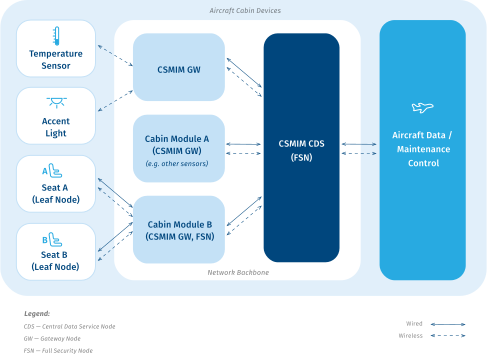
Examples of Aircraft Cabin Devices
-
Temperature Sensor: Measuring cabin temperature.
-
Accent Light: Ambient lighting control within the cabin.
-
Seat A and Seat B (Leaf Node): These nodes are associated with individual seats and provide functionality like monitoring, control, or telemetry specific to the seats.
-
Aircraft Data / Maintenance Control: The systems use the data processed by the Central Data Service Node for various functions, including routine maintenance, fault detection, and overall aircraft management. This can help with predictive maintenance and operational efficiency.
Network Backbone
This core communication link facilitates data exchange between nodes (gateway and central nodes) and integrates the cabin systems with the aircraft’s broader operational systems.
-
CSMIM CDS (Central Data Service Node): The central node aggregates, processes, and manages the data the gateway nodes collect. It is a central hub for all cabin-related data, ensuring that information is efficiently processed and stored.
-
CSMIM GW (Gateway Node): These gateway nodes act as intermediaries that collect data from various cabin devices. Multiple such gateways (Cabin Module A and Cabin Module B) are dedicated to different sections or types of devices within the cabin.
-
A Full Security Node (FSN) is a device that can perform all tasks defined by the CSMIM standard. It acts as both a network participant and an infrastructure component responsible for overall network management and security functions such as key distribution, authentication, and message exchange facilitation between other nodes on the network.
-
A Leaf Node is a device that performs simple tasks within the CSMIM system, primarily focused on sensing or actuating rather than networking. These devices communicate with FSNs to send and receive application data packets but do not participate in managing the overall network infrastructure. They are often battery-powered sensors or other resource-constrained devices designed for energy conservation during normal operation.
Benefits of CSMIM
-
Standardized Interoperability — Devices from different manufacturers can interact without compatibility issues, promoting a diverse equipment ecosystem within aircraft cabins. This is as well possible for organizations or developers to implement their own software solutions that utilize the CSMIM architecture and protocols. The CSMIM standard defines a common framework for communication between various devices in an intelligent transportation system, allowing different vendors and organizations to develop interoperable applications and systems based on this shared understanding of data exchange and security mechanisms.
-
Cost Reduction and Maintenance Efficiency — Standardization reduces costs associated with maintaining and upgrading systems, as parts and systems from various suppliers are interchangeable.
-
Faster Time To Market — CSMIM makes it easier for airlines and manufacturers to adopt new technology without extensive customizations, enabling faster time-to-market and rapid adoption of game-changing capabilities.
-
Enhanced Passenger and Crew Experience — CSMIM enables personalized services and the ability to monitor and control systems, such as adjustable lighting and temperature settings, improving satisfaction and loyalty.
-
Flexibility — The open nature of CSMIM allows integration with tertiary systems and services outside the aircraft, such as building automation or ground handling equipment at airports.
-
Innovation and Market Adaptability — CSMIM encourages the adoption of emerging technologies like IoT and AI, facilitating rapid integration and market readiness.
-
Improved Security — A standardized protocol allows for better implementation of security measures across diverse systems, minimizing vulnerabilities.
-
Environmental Impact — Optimized system performance through standardized communication leads to better energy usage and reduced ecological footprint.
Use-cases
The CSMIM Protocol can be applied in numerous ways within aircraft systems to enhance connectivity and integration of cabin components.
Some use-cases:
-
Automated cabin management — Integration of various cabin functions such as temperature control, air quality monitoring, and entertainment systems through a central management system that uses CSMIM for seamless communication and control.
-
Smart lighting control — Utilizing CSMIM to manage cabin lighting systems, enabling dynamic adjustments based on time of day, occupancy, or passenger preferences, thereby enhancing passenger comfort and reducing energy consumption.
-
Predictive maintenance of cabin systems — Utilizing CSMIM to gather and analyze data from various cabin components, such as HVAC and lighting, to predict and schedule maintenance will reduce downtime and improve operational efficiency.
-
Software and firmware updates — Ground-based systems can trigger or schedule the download and installation of software updates for non-critical systems, such as in-flight entertainment or cabin management systems, when the aircraft is on the ground.
-
Temperature sensors for sensitive cargo — For flights carrying temperature-sensitive cargo (like pharmaceuticals), CSMIM-enabled sensors can provide continuous temperature readings. This ensures that the cargo is maintained within safe parameters, with alerts sent if conditions deviate from the set norms.
-
Safety equipment status — Safety devices like life vests and emergency exit signs equipped with CSMIM connectivity can report their status (e.g., operational, malfunctioning, or missing) to ensure all safety equipment is checked and accounted for without manual inspections.
-
Passenger App Integration — Passengers could use an airline’s mobile application to communicate with the CSMIM system onboard. After boarding, the app could display the current location of the passenger’s luggage, indicating the specific overhead compartment or storage area where it has been placed.
-
Instant Updates — During the flight, if the luggage is moved (e.g., by cabin crew rearranging items to accommodate more bags or access emergency equipment), the system would update the new location instantly, ensuring that the passenger always has the latest information.
Challenges and Solutions
-
Integration with Legacy Systems — While integrating CSMIM with older systems poses challenges, the protocol’s design includes backward compatibility features to ease transitions.
-
Cross-Industry Standardization — Expanding CSMIM to interact with non-aviation systems requires ongoing collaboration with other sectors, which CSMIM supports through its open-platform nature.
-
Technology Readiness — Transition to CSMIM will require expertise in the protocol and thought-through approach for its adoption.
Conclusion
Adopting the Cabin Secure Media-Independent Messaging (CSMIM) Protocol across various applications within aircraft systems offers multiple benefits. It enables more effective and standardized communication between diverse systems and devices from different manufacturers, enhancing interoperability and system integration. This results in more efficient operations and improved manageability of the aircraft’s electronic and mechanical components.
CSMIM facilitates the remote monitoring and control of systems, allowing for proactive maintenance and swift response to issues, improving reliability and reducing downtime. Furthermore, it supports enhancing passenger experiences through customized services like personalized cabin conditions, streamlined in-flight entertainment, and information updates. CSMIM helps build a more connected, efficient, and passenger-centric aircraft environment.
About Axinom
Axinom enables aerospace enterprises with the tools to thrive amidst the dynamic digitalization landscape. Our products boast adaptable and standardized architecture, perfectly tailored to the distinctive data requirements of ground operations and in-flight services.
With over two decades in the industry, Axinom understands the underlying challenges and offers flexible and open solutions spanning in-flight connectivity, entertainment, secure content delivery, comprehensive fleet management, and efficient content distribution.


